The best grinder for a beginner is not necessarily the one with the highest motor torque. Workbench area, bit sizes, water delivery and voltage often make a bigger difference to a small hobby studio. Manufacturer-published specs are useful, but they do not tell us which machine is quietest in an independent test.
Consider compact machines for tiny suncatchers, mid-size table designs for frequent work, and large tables for larger panels. Inland models in this catalog use 115V supplies, while some Techniglass models offer broader voltage compatibility. Always verify the exact market variant.
Before you begin: set up the right conditions
Use a stable, clutter-free workstation. Keep safety glasses within reach and contain fragments, dust and slurry. Match tool voltage and operating conditions to the manual. If your work involves solder, set up effective ventilation and lead-safe hygiene practices before opening flux or heating an iron.
Equipment choice is a sequence of tradeoffs. A tool that is convenient for a small suncatcher may be poorly suited to a large lead-came panel. Match the task and the actual glass pieces instead of relying on generic five-star ratings, unexplained price rankings or marketing labels.
Choose equipment and materials deliberately
Look for manufacturers that publish real specifications, manuals and replaceable parts. Confirm the exact model name and any regional variants. When shopping on Amazon, a model-specific search can be useful for comparing offers, but the search page itself does not verify that a suitable variant is available or that a listing is genuine.
The workflow in context
Most stained-glass projects involve tracing, controlled scoring and breaking, selective wet grinding, clean foiling and careful soldering. Focus on the part relevant to your current task while preserving fit for the next stage. For example, excessive grinding can make a foil seam unusually wide and difficult to solder neatly.
A good inspection habit is to pause between operations and compare the piece against the original full-size pattern. It is easier to recut a poor shape before foiling than to disguise an inaccurate join with excessive solder.
Step-by-step instructions
Step 1: Decide which glass sizes you actually use
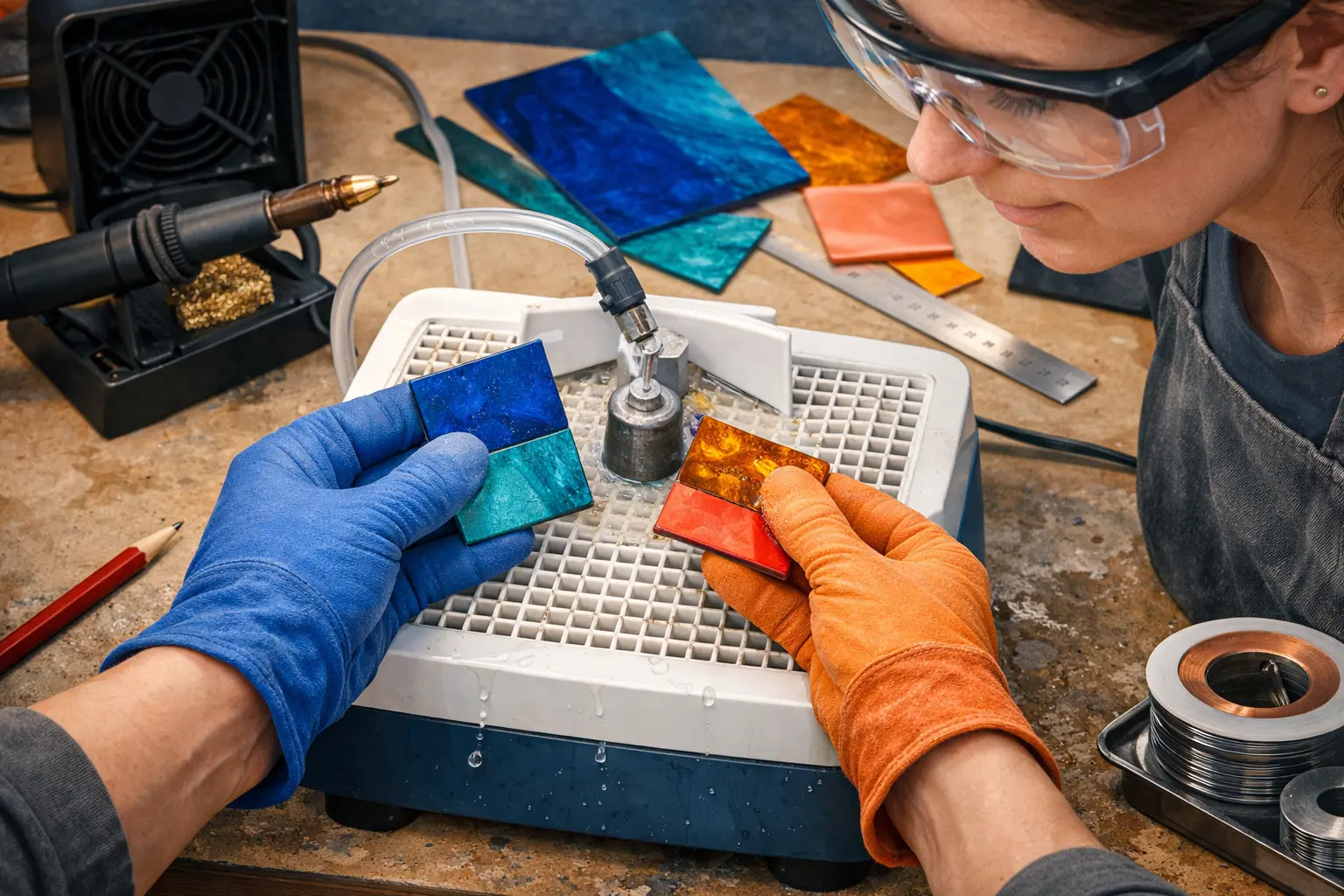
Measure the typical pieces in your pattern and determine whether a compact grid will support them securely.
Step 2: Choose your voltage and work surface
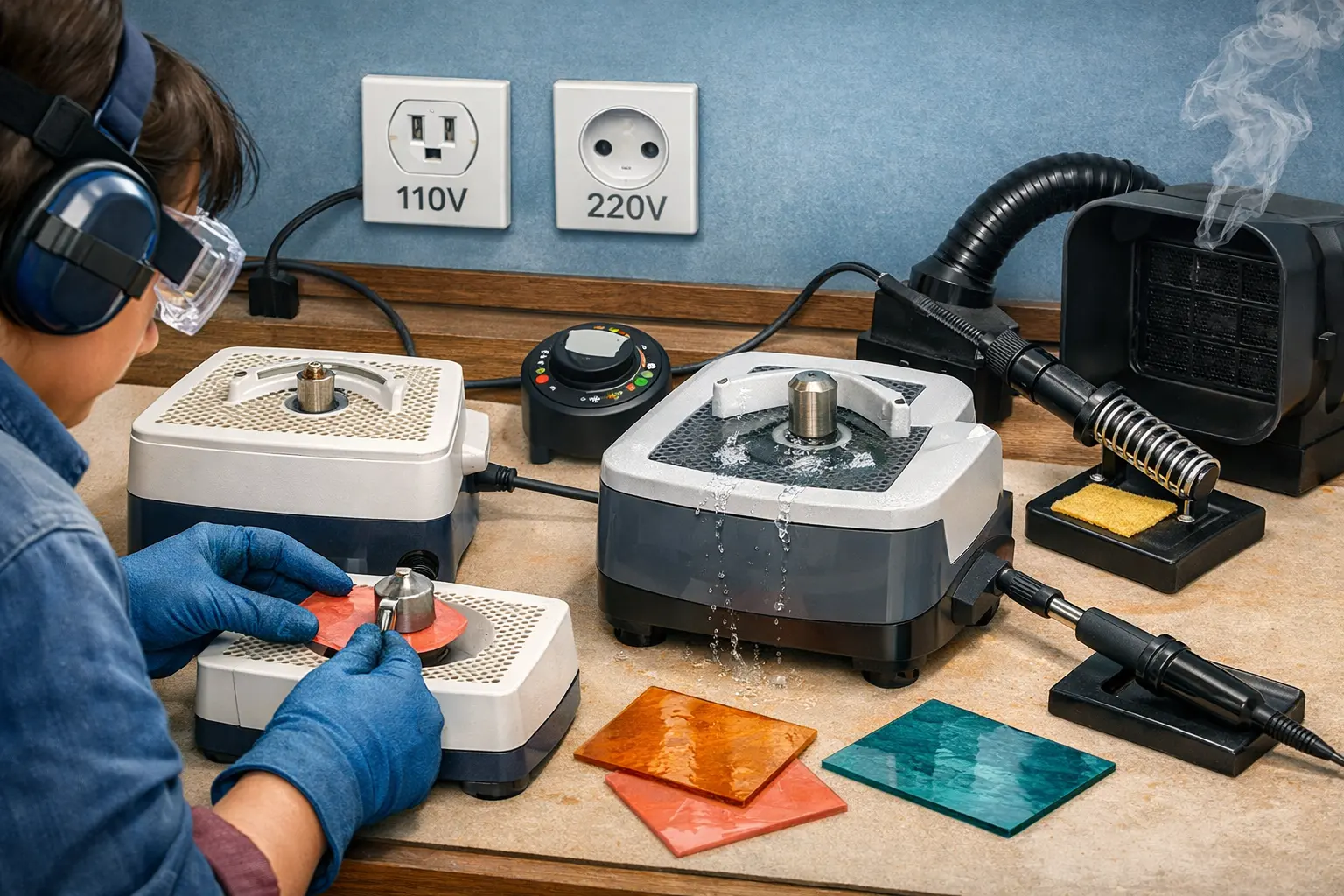
Check plug and voltage specifications for your country. Compare the main grid, not just the overall body dimensions.
Step 3: Compare included grinding bits
A 3/4-inch bit is common for general edge shaping. Smaller bit sizes may help detail work but require appropriate machine and accessory support.
Step 4: Compare the water-delivery method
Some systems use damp sponges and others use brushes. The important part is reliable wet grinding while following the approved care routine.
Step 5: Budget for safety and replacements
Allow for eyewear, correct bits, cleaning and servicing. Remember to compare replacement supplies and manufacturer support.
Common problems and how to respond
- The Inland WizlingCG uses 16 oz-in published torque; WizCG 30 oz-in and Wizard IV 40 oz-in.
- Techniglass GRINDER 2 lists 57 oz-in torque and 4,500 RPM, but differently designed machines should not be ranked on torque alone.
- The Wiz Mini has a 6.5 × 6.5-inch work surface; it can be more portable but less suitable for larger panes.
- Manufacturer quietness claims are not equivalent to measured decibel comparisons.
When should you upgrade your equipment?
Upgrade after identifying a recurring limitation in the tools you own. For beginners, handling skill and a sound process are often more useful than buying the highest-powered machine immediately. For regular makers, bigger tables, compatible detail bits or better bit-change systems can reduce friction and improve repeatability.
If you are selecting a new wet grinder, compare documented models below. Some have substantially different voltage requirements, included grinding bit sizes and accessory ecosystems. The machine with the most impressive headline number may not be the one that fits your actual bench.
Compare documented specifications, fit and limitations, or check current Amazon listings. Amazon searches may include different models.
How this lesson connects to the rest of the craft
Continue with the complete suncatcher project to see the entire sequence. If your glass edges do not meet the pattern, read wet grinder technique. When the surface is clean and shaped correctly, move on to applying copper foil and controlled soldering.
What motor specifications actually tell you
Motor speed and published torque help compare a manufacturer’s models, but they are not a complete measure of edge quality, noise or long-term reliability. The Inland WizlingCG and WizCG both list 3,500 RPM while their torque ratings differ: 16 oz-in versus 30 oz-in. The larger Wizard IV lists 40 oz-in and a substantially larger table. These numbers make useful comparisons within the range, but still need context.
Techniglass lists a 57 oz-in torque figure for THE GRINDER 2 and a 4,500 RPM motor. Machine architecture, bit characteristics and water delivery differ from Inland’s design, so simply choosing the largest number is not a reliable buying method. Focus on whether the grinder can support your typical glass and whether you can obtain the proper consumables.
Compare the grinder as a whole system
The machine and bit are only part of the total buying decision. A grinder has a water-handling system, a work grid, a splash strategy and a replaceable abrasive head. Included bit sizes can change the startup budget. Inland WizCG includes a 3/4-inch and 1/4-inch bit, while Techniglass THE GRINDER 2 includes a Quick-Fit bit system with a different replacement approach.
Consider how frequently you expect to switch between ordinary edges and tiny internal details. An elaborate accessory ecosystem can be worthwhile for experienced makers, but a beginner may value simple reservoir cleaning and a sturdy table. Make sure parts are available locally before committing to a niche bit or optional upper platform.
Shop based on the real size of your glass
An equipment table needs to support the part being ground without awkwardly twisting the glass. If you mostly make small 4–8 inch ornaments, a compact grinder may fit comfortably on the bench. For large panel pieces, a wider grid can provide more stable support while you move the edge along the bit.
The published work surfaces differ significantly: Inland Wiz Mini is roughly 6.5 inches square, the WizlingCG and WizCG share a 10.5-by-8.5-inch table, and the Wizard IV reaches 14.5 by 11.5 inches. These are manufacturer figures, not proof one model performs better. Think about the actual largest piece you will handle regularly.
Avoid mistakes with electrical variants and Amazon listings
Some models carry a 115V rating intended for North American installations, while certain Techniglass grinders publish multi-voltage support. Do not assume a product name guarantees the same included cord or regional package across all sellers. Confirm the precise electrical rating, plug, warranty and bit compatibility before buying.
Our shopping buttons may lead to an Amazon search when no exact ASIN has been independently matched. The search can contain accessories, lookalike products or third-party variants. Use the manufacturer documentation linked from the permanent model page to compare the actual Amazon offer, and do not rely on automatically displayed star ratings or stale price snippets.
Sources and manuals
- Inland Craft: Wet Grinder Product Rangeinlandcraft.com
- Techniglass: Grinder Model Comparisontechniglass.com